Andrew Bird, "Scythian Empires," live on WNYC Soundcheck.
Andrew Bird's Armchair Apocrypha must be on everybody's short list for best record of 2007. If it's not on yours, then please throw your list away and start again. I've been listening to it pretty consistently since it came out in March (and blogged about it here, here, and here) although I've particularly had Bird on the brain as of late. The two things that I love most about this record are as follows.
First, it is a record, not just a oddly compiled collection of songs. You put this thing on, and you listen to the whole thing, in order, and every song is perfectly placed, and the thing just flows.
Second, even though the true genius of the record is not fully unleashed unless you listen to it as set forth more fully above, it also has a bunch of killer individual songs that call for careful, individual dissection.
To properly dissect a song, as you must know by now, you first listen to the song on repeat for anywhere between one hour and four weeks, until you have gotten underneath both the words and the music. Second, if the liner notes are provided, of course they must be devoured. Third, if you are in middle school, and are required to do that weird thing where you cover your text books in grocery bag like so then you must scrawl the song lyrics on said cover. Finally, you must find alternative versions of the song to see how the artist interprets the song away from the friendly confines of the record proper.
This all might seem like a quaint exercise in a post-Napster world, but if you, little you, are to understand and fully grasp the brilliance set forth before you, you must follow these instructions with unwavering precision.
Andrew Bird, Scythian Empires, An Applied Case Study.
1. Know the song, love the song: Usually I can only listen to this song a few times a week because as I had yet to tame its brilliance listening to it once inevitably turned into listening to it for four straight hours, which killed the chance of completing whatever task it was that I was procrastinating over by putting on Andrew Bird in the first place. Luckily, I had some time on my hands recently when I made a drive of roughly 350 miles that due to pre-holiday traffic took roughly seven hours to complete. Lesser men might have gone insane. I resolved to get to the bottom of Scythian Empires. And by this I mean, I listened to Scythian Empires. Non-stop. For 350 straight miles. For seven straight hours. I shall know Scythian Empires; Scythian Empires shall know my devotion.
2. Hard copy of the album secured, I got underneath the words. This was actually done while driving. But don't worry, the excess of cars on the road made it very safe for me to attempt the simultaneous reading/driving exercise.
3. I am not in Middle School, so this step does not apply to me, unfortunately. And what a shame. Because to be a middle-schooler, in 2007, stuck amidst war and chaos and corruption and the suburbs, and to walk into Social Studies class with eyes sad, heavy, and knowing, and having the following handwritten on your textbook: "Five day forecast brings black tar rain and hellfire/while handpicked handler's kid gloves tear at the inseams/their Halliburton attache cases are useless/while Scotch-Guard Macintoshes shall be carbonized/now they're offering views of exiting empires/such breathtaking views of Scythian empires..." would be so profound that you'd probably get a scholarship to Sarah Lawrence on the spot.
4. The alternative version. I present you with this below. It's actually an entire in-studio interview and performance, but if you are running short on time, then scroll ahead to 16:16 and listen to the performance of Scythian Empires. This song is so grand and ambitious as it appears on the record, but this version just totally conquers. People! You do not hear songs like this every day. So it is imperative that you listen to this, and support this, and soak it all in; the fate of our culture as one that is generous and fertile and creative may very well rest on your decision.
Monday, September 03, 2007


Saturday, September 01, 2007
(09.01.07) Recommends:
Western States Motel.
So, have you ever been in the outside part of a bar, and then when you come back in to pay your tab there is a band playing live in the background, and as you are signing the check, you turn and you see Natalie Portman, and she asks if you know the band, and while asking, she sorta lunges toward you and says, they’ll change your life, I swear?
No? That’s never happened to you? Okay. More or less it’s never happened to me, either. However.
However.
I was out the other night. Out of doors on a warm summer night. And then I came inside the doors. To pay my bar tab which, it should be noted, was a very reasonable amount, because I am a reasonable person and only engage in reasonable behavior, even when the other youth of the city are bursting with energy and virility and irrationality. I, for the record, am reasonable. As are those with whom I hang out at these bars on these warm summer nights.
And as I was signing that bar tab...and heard that music...I turned my head around...and looked at the band on the stage...but first I picked my chin off of the floor, where it had been resting in amazement.
After frantically running – literally, running – around the bar, trying to figure out who these songsters were, somebody at the merch table informed me: Western States Motel.
I saw the band perform threes songs – five, tops. And by the end, I declared it the best show I had seen in the last six months. Live, they were this rollicking alt country band, dressed in sharp brown rockabilly suits. Possibly the suits were brown. After all, I’m mostly blind, so I’m more or less guessing at the color. But the point remains: the band was phenomenal and I decided I would pick up their record the next day.
It turns out their record is completely different than their live show. Much poppier. And after one spin I was thinking it must have been the alcohol that made the band sound so good. But I kept listening and then it hit me: It turns out that even the album is phenomenal. It’s like a mixture of the Shins, and Elliot Smith, and a host of those cosmic-Americana bands from Los Angeles, like The Elected (blogged about here), Irving (blogged about here), Beechwood Sparks.
So, here’s the deal. Go to their myspace and give them a listen. If the sound isn’t working for you, rip that computer out of the wall, and put it in your car. This record comes alive on the road. This works particularly well if you live near a winding highway that dramatically overlooks the Pacific Ocean. If you don’t have that handy, perhaps you have a large lake (natural or manmade is okay). If no lake, perhaps there is a neighborhood pool that you could drive around while blasting this (don’t forget the zinc oxide for your nose, bacon slice!). If no neighborhood pool, then at least turn your TV to Mtv, to one of those dramas like The Hills or Laguana Beach. Then turn the volume off, and pump up Western States Motel. Because this music will be featured on these shows very very soon.
And regardless of the virtues of those shows, this music needs to be listened by many, many people.
So, have you ever been in the outside part of a bar, and then when you come back in to pay your tab there is a band playing live in the background, and as you are signing the check, you turn and you see Natalie Portman, and she asks if you know the band, and while asking, she sorta lunges toward you and says, they’ll change your life, I swear?
No? That’s never happened to you? Okay. More or less it’s never happened to me, either. However.
However.
I was out the other night. Out of doors on a warm summer night. And then I came inside the doors. To pay my bar tab which, it should be noted, was a very reasonable amount, because I am a reasonable person and only engage in reasonable behavior, even when the other youth of the city are bursting with energy and virility and irrationality. I, for the record, am reasonable. As are those with whom I hang out at these bars on these warm summer nights.
And as I was signing that bar tab...and heard that music...I turned my head around...and looked at the band on the stage...but first I picked my chin off of the floor, where it had been resting in amazement.
After frantically running – literally, running – around the bar, trying to figure out who these songsters were, somebody at the merch table informed me: Western States Motel.
I saw the band perform threes songs – five, tops. And by the end, I declared it the best show I had seen in the last six months. Live, they were this rollicking alt country band, dressed in sharp brown rockabilly suits. Possibly the suits were brown. After all, I’m mostly blind, so I’m more or less guessing at the color. But the point remains: the band was phenomenal and I decided I would pick up their record the next day.
It turns out their record is completely different than their live show. Much poppier. And after one spin I was thinking it must have been the alcohol that made the band sound so good. But I kept listening and then it hit me: It turns out that even the album is phenomenal. It’s like a mixture of the Shins, and Elliot Smith, and a host of those cosmic-Americana bands from Los Angeles, like The Elected (blogged about here), Irving (blogged about here), Beechwood Sparks.
So, here’s the deal. Go to their myspace and give them a listen. If the sound isn’t working for you, rip that computer out of the wall, and put it in your car. This record comes alive on the road. This works particularly well if you live near a winding highway that dramatically overlooks the Pacific Ocean. If you don’t have that handy, perhaps you have a large lake (natural or manmade is okay). If no lake, perhaps there is a neighborhood pool that you could drive around while blasting this (don’t forget the zinc oxide for your nose, bacon slice!). If no neighborhood pool, then at least turn your TV to Mtv, to one of those dramas like The Hills or Laguana Beach. Then turn the volume off, and pump up Western States Motel. Because this music will be featured on these shows very very soon.
And regardless of the virtues of those shows, this music needs to be listened by many, many people.
Sunday, August 26, 2007
(08.26.07) Recommends:
Kitchen Clam Bake!
What better way to get the taste out of my mouth from yesterday's unmitigated disaster then to have a tasty dinner. The Food Network has been hyping the Clam Bake lately, so we turned to everybody's favorite secret crush, Rachael Ray, for a recipe. We modified things a bit here and there, but still hope we did Ra Ra proud.
First up, a 16-quart stock pot:

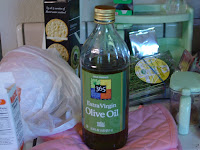
Then, a little of Ra Ra's favorite magic sauce:
What goes well with a big pot and oil? If you said, "plate full of andouille and kielbasa," congratulations, you are correct:

Potatoes, in the hashed manner. This was the most questionable move of the evening, and I take full responsibility. Ra Ra (stop shaking your head out there; my use of this nickname should not make you nervous and/or sad) called for a "16-ounce bag frozen diced hash browns." But it's unclear whether this is what she had in mind:

One large onion, chopped:

Action Shot!

What form! What fingers! Have you ever seen 4 ribs celery, chopped, with such finesse? No, the answer to that question is no.

Seems like a good point to start filling up that big pot:

Stirring occasionally the potatoes, onions, celery, bay leaf, salt and pepper and:

Thyme. We've only just begun, but it's already starting to look like Grandma's Famous Slaw:

Now that you mention slaw, next up is four ears of corn, complete with caterpillar. No really, that little curled up booger you see right below the tip of the earn of corn isn't a booger after all. It is a caterpillar. Now that's organic!

Action Shot!

When I spy caterpillars in my corn I act swiftly and without mercy. No, No, I'm not a hand model. Yes, yes, I know it's a waste of god-given talent that I'm not.
How do you like me now:

Note: The next picture is probably NSFW, so scroll accordingly.
Naked shrimp:

Now all dressed up, but only one place to go:

Action Shot! with chicken stock:

Action Shot! with tomatoes:

Action Shot! with salt:

Note to self: no bearded clam jokes, no bearded clam jokes, no bearded clam jokes...

Mixing muscles and clams:

No need resorting to 16-year old humor when you've got this staring back at you:

Wait, it gets better:

Put the top on and wait about ten minutes. Take the top off, and through the fog we get...

...Jackpot! Good golly, that is a serious pot of food:

Add some hot sauce to taste:

And you're left with a bowl of nearly unbearably awesome goodness:

No need to risk playing Scrabble on an empty stomach:

14.7 seconds later:

Discarded shells in the foreground. "Goonies" in the background. How long can the good life last?

Well, through the magic of refrigeration, I'm willing to bet that the good life can last a few more days:

What better way to get the taste out of my mouth from yesterday's unmitigated disaster then to have a tasty dinner. The Food Network has been hyping the Clam Bake lately, so we turned to everybody's favorite secret crush, Rachael Ray, for a recipe. We modified things a bit here and there, but still hope we did Ra Ra proud.
First up, a 16-quart stock pot:

Then, a little of Ra Ra's favorite magic sauce:

What goes well with a big pot and oil? If you said, "plate full of andouille and kielbasa," congratulations, you are correct:

Potatoes, in the hashed manner. This was the most questionable move of the evening, and I take full responsibility. Ra Ra (stop shaking your head out there; my use of this nickname should not make you nervous and/or sad) called for a "16-ounce bag frozen diced hash browns." But it's unclear whether this is what she had in mind:

One large onion, chopped:

Action Shot!

What form! What fingers! Have you ever seen 4 ribs celery, chopped, with such finesse? No, the answer to that question is no.

Seems like a good point to start filling up that big pot:

Stirring occasionally the potatoes, onions, celery, bay leaf, salt and pepper and:

Thyme. We've only just begun, but it's already starting to look like Grandma's Famous Slaw:

Now that you mention slaw, next up is four ears of corn, complete with caterpillar. No really, that little curled up booger you see right below the tip of the earn of corn isn't a booger after all. It is a caterpillar. Now that's organic!

Action Shot!

When I spy caterpillars in my corn I act swiftly and without mercy. No, No, I'm not a hand model. Yes, yes, I know it's a waste of god-given talent that I'm not.
How do you like me now:

Note: The next picture is probably NSFW, so scroll accordingly.
Naked shrimp:

Now all dressed up, but only one place to go:

Action Shot! with chicken stock:

Action Shot! with tomatoes:

Action Shot! with salt:

Note to self: no bearded clam jokes, no bearded clam jokes, no bearded clam jokes...

Mixing muscles and clams:

No need resorting to 16-year old humor when you've got this staring back at you:

Wait, it gets better:

Put the top on and wait about ten minutes. Take the top off, and through the fog we get...

...Jackpot! Good golly, that is a serious pot of food:

Add some hot sauce to taste:

And you're left with a bowl of nearly unbearably awesome goodness:

No need to risk playing Scrabble on an empty stomach:

14.7 seconds later:

Discarded shells in the foreground. "Goonies" in the background. How long can the good life last?

Well, through the magic of refrigeration, I'm willing to bet that the good life can last a few more days:

Saturday, August 25, 2007
(08.25.07) Recommends:
Remaining Professional While Flying Your "Indie" Flag.
Okay, so I've got a rant pent up in me. I don't like to use this space to be negative as I prefer to focus on things that inspire me. But today I had a pretty horrible experience, and because I presume that I was the target audience of the event, some constructive criticism might be useful.
So. Today I headed out to the 2007 Bay Area Indie Music Festival. The gist of the festival was simple and enticing: 20 up-and-coming Bay Area bands on two stages from noon to 10pm, all for ten bucks. Sounds great, right? That's what I thought, too.
I rolled up to the venue in Martinez a little after noon. No band anywhere in sight. Like one sound dude. I thought this looked awkward, but I gave it the benefit of the doubt, after all it was a beautiful day and I was thinking I was in for a cool afternoon of music. But the minutes kept passing without a noticeable sign of getting the festival started. So I went and used the journalism skills I gained in high school. What I found out wasn't hopeful: the sound crew had apparently quit the night before, and they were also now down to just one stage. By 1pm there was still no sign of progress, so I left to explore Martinez. The highlight of the afternoon was walking around downtown Martinez in a KU shirt and running into a KU alumni and chatting for about ten minutes about Lawrence.
I arrived back at the venue at about 2:15 to hear the last few songs of the first band of the day. Now, using the word "Indie Music" in the name of your festival is a gutsy move because if the music turns out to be crap then lots of people like me will think you've used the word to try to get people like me to give you my money. And that's pretty obnoxious, right? So, this first band was completely completely cheesy. Something I would expect to see playing at a barbeque joint in Kansas City on a Thursday night. Completely cheesy rock 'n roll blues blah blah blah music.
The second band had a lead singer who was desperately trying to look like Pete Wentz. Pete fucking Wentz? Give me a break. Consulting my show program, it looked like anywhere between 1/5 and 1/3 of the bands had lead singers desperate to look like Pete Wentz. My god. Is Fall Out Boy considered indie music? Last time I checked they were considered, er, "shitty music." That is, unless you're like a 16-year old girl. Attention Organizers of the Bay Area Indie Music Fest: are you trying to go after people like me, or 16-year old girls? Here's the thing: 16-year old girls have every right to have a music scene that they can get behind. But so many of the bands on the venue were billed as, e.g., selling out the Independent, or selling out Bottom of the Hill. These are 21+ venues, though, so it must be that you are catering to fans like me, right? So then, why all the FOB lead singers? I don't like FOB. None of my friends like FOB. Nobody with whom I've seen a show in the bay area likes FOB. So what was the point of the festival?
The organizers might say, well, if you go to so many indie shows in the bay area, then you have no doubt dealt with long delays before the headliner came on stage. And this is a valid point. But I'm not at a rock club. I'm at an amphitheater in Martinez. It's a hot Saturday. We live in the Bay Area, which means there are almost limitless opportunities to spend my day. So have the decency to get on the PA and explain to me the hold up.
Either way, if you are aiming for the teen crowd, or for me, couldn't you have been professional enough to get somebody on the PA to explain to the crowd why everything was so damn behind schedule?
So, after the second crappy band of the day I went exploring around the venue. I picked up a $5 plastic cup of Bud Lite, apparently the Official Beer of Indie Music. I tried to drown my sorrow over this experience in that 8 ounce cup of beer. Is "indie music" really this lame? Is it just "Bay Area" "indie music" that is this lame?
I consider "indie rock" to be the current musical epoch in which we find ourselves. It supplanted "alternative rock/grunge rock" which supplanted "hair metal" as the previously prevailing musical epochs. Now, the "alternative rock" epoch officially became irrelevant when bands like Stone Temple Pilots got big, because they were like knock-offs of the bands like Nirvana who defined "alternative rock." Nirvana itself knocked off a lot of music, but managed to be creative in its derivativeness. Meanwhile shitty bands like Stone Temple Pilots were just derivative without adding anything interesting to the mix.
Are we now at the tail end of the "indie rock" epoch? Because the bands I saw today were just rehashing played stuff, and it was kind of embarrassing and sad. I sat through one more band, some screamo, emocore, yadda yadda whatever stuff. By that time it was 4pm. Three bands had played by 4pm, and 20 were on the bill. Not wanting to camp out in Martinez until Wednesday afternoon, I left.
The whole ride home, I listened to my new Meiko CD, wishing I was back watching her play at the Hotel Cafe in Los Angeles. To recap this week's culture war:
Los Angeles: 1
Bay Area: 0
End Note: The festival organizers should not put on a 2nd Annual event until they (a) fully articulate the point of having this festival; and (b) are professional enough to pull off something like this.
Okay, so I've got a rant pent up in me. I don't like to use this space to be negative as I prefer to focus on things that inspire me. But today I had a pretty horrible experience, and because I presume that I was the target audience of the event, some constructive criticism might be useful.
So. Today I headed out to the 2007 Bay Area Indie Music Festival. The gist of the festival was simple and enticing: 20 up-and-coming Bay Area bands on two stages from noon to 10pm, all for ten bucks. Sounds great, right? That's what I thought, too.
I rolled up to the venue in Martinez a little after noon. No band anywhere in sight. Like one sound dude. I thought this looked awkward, but I gave it the benefit of the doubt, after all it was a beautiful day and I was thinking I was in for a cool afternoon of music. But the minutes kept passing without a noticeable sign of getting the festival started. So I went and used the journalism skills I gained in high school. What I found out wasn't hopeful: the sound crew had apparently quit the night before, and they were also now down to just one stage. By 1pm there was still no sign of progress, so I left to explore Martinez. The highlight of the afternoon was walking around downtown Martinez in a KU shirt and running into a KU alumni and chatting for about ten minutes about Lawrence.
I arrived back at the venue at about 2:15 to hear the last few songs of the first band of the day. Now, using the word "Indie Music" in the name of your festival is a gutsy move because if the music turns out to be crap then lots of people like me will think you've used the word to try to get people like me to give you my money. And that's pretty obnoxious, right? So, this first band was completely completely cheesy. Something I would expect to see playing at a barbeque joint in Kansas City on a Thursday night. Completely cheesy rock 'n roll blues blah blah blah music.
The second band had a lead singer who was desperately trying to look like Pete Wentz. Pete fucking Wentz? Give me a break. Consulting my show program, it looked like anywhere between 1/5 and 1/3 of the bands had lead singers desperate to look like Pete Wentz. My god. Is Fall Out Boy considered indie music? Last time I checked they were considered, er, "shitty music." That is, unless you're like a 16-year old girl. Attention Organizers of the Bay Area Indie Music Fest: are you trying to go after people like me, or 16-year old girls? Here's the thing: 16-year old girls have every right to have a music scene that they can get behind. But so many of the bands on the venue were billed as, e.g., selling out the Independent, or selling out Bottom of the Hill. These are 21+ venues, though, so it must be that you are catering to fans like me, right? So then, why all the FOB lead singers? I don't like FOB. None of my friends like FOB. Nobody with whom I've seen a show in the bay area likes FOB. So what was the point of the festival?
The organizers might say, well, if you go to so many indie shows in the bay area, then you have no doubt dealt with long delays before the headliner came on stage. And this is a valid point. But I'm not at a rock club. I'm at an amphitheater in Martinez. It's a hot Saturday. We live in the Bay Area, which means there are almost limitless opportunities to spend my day. So have the decency to get on the PA and explain to me the hold up.
Either way, if you are aiming for the teen crowd, or for me, couldn't you have been professional enough to get somebody on the PA to explain to the crowd why everything was so damn behind schedule?
So, after the second crappy band of the day I went exploring around the venue. I picked up a $5 plastic cup of Bud Lite, apparently the Official Beer of Indie Music. I tried to drown my sorrow over this experience in that 8 ounce cup of beer. Is "indie music" really this lame? Is it just "Bay Area" "indie music" that is this lame?
I consider "indie rock" to be the current musical epoch in which we find ourselves. It supplanted "alternative rock/grunge rock" which supplanted "hair metal" as the previously prevailing musical epochs. Now, the "alternative rock" epoch officially became irrelevant when bands like Stone Temple Pilots got big, because they were like knock-offs of the bands like Nirvana who defined "alternative rock." Nirvana itself knocked off a lot of music, but managed to be creative in its derivativeness. Meanwhile shitty bands like Stone Temple Pilots were just derivative without adding anything interesting to the mix.
Are we now at the tail end of the "indie rock" epoch? Because the bands I saw today were just rehashing played stuff, and it was kind of embarrassing and sad. I sat through one more band, some screamo, emocore, yadda yadda whatever stuff. By that time it was 4pm. Three bands had played by 4pm, and 20 were on the bill. Not wanting to camp out in Martinez until Wednesday afternoon, I left.
The whole ride home, I listened to my new Meiko CD, wishing I was back watching her play at the Hotel Cafe in Los Angeles. To recap this week's culture war:
Los Angeles: 1
Bay Area: 0
End Note: The festival organizers should not put on a 2nd Annual event until they (a) fully articulate the point of having this festival; and (b) are professional enough to pull off something like this.
Friday, August 24, 2007
(08.24.07) Recommends:
A Meiko Update.
So I headed down to Los Angeles earlier this week to take in two Meiko shows. I've posted about her here and here. She is in the midst of a Wednesday residency at the Hotel Cafe. And this week, she also had an early Tuesday show. Early like 6pm. And with traffic the way it is in Los Angeles, there were probably 25 people at her Tuesday show. But that didn't hold her back at all. Meiko was meant for the stage; she's a natural born rock star. She is so at ease up there. She is very warm, and funny, and tells funny stories, and comes up with funny nicknames (example: calling her trumpet player Donald Trump-et). She has such a distinct voice: she's from Georgia, and the way she plays with the Southern accent just kills.
At this point, I should also gush about the Hotel Cafe. It is one of the coolest venues I've been to. It is what I picture of a music club in LA: a totally non-nondescript front, you have to enter through a back alley, to get into the club you have to walk through heavy curtains, inside there is a front bar room, then a door that leads to a very intimate music room that comfortably fits probably 300.
I wish I had pictures to share of the shows, but they requested no flash photography, and it was just too dark for me get anything worth posting.
Anyway, both shows were fantastic. If you are in or around LA this Wednesday, she has her final Wednesday date before she embarks on a month long tour across the country opening for Brett Dennen.
Finally, I've been getting a ton of hits from people looking for a "reasons to love you" mp3. I briefly thought about putting my copy of her CD up on yousendit, but I quickly realized that I couldn't do that even if I wanted to, because free music is cool and all, but making somebody else's music free isn't up to me. At any rate, Meiko is streaming her whole album (minus an awesome hidden song), at her website. So all of you looking for here stuff click here immediately.
So I headed down to Los Angeles earlier this week to take in two Meiko shows. I've posted about her here and here. She is in the midst of a Wednesday residency at the Hotel Cafe. And this week, she also had an early Tuesday show. Early like 6pm. And with traffic the way it is in Los Angeles, there were probably 25 people at her Tuesday show. But that didn't hold her back at all. Meiko was meant for the stage; she's a natural born rock star. She is so at ease up there. She is very warm, and funny, and tells funny stories, and comes up with funny nicknames (example: calling her trumpet player Donald Trump-et). She has such a distinct voice: she's from Georgia, and the way she plays with the Southern accent just kills.
At this point, I should also gush about the Hotel Cafe. It is one of the coolest venues I've been to. It is what I picture of a music club in LA: a totally non-nondescript front, you have to enter through a back alley, to get into the club you have to walk through heavy curtains, inside there is a front bar room, then a door that leads to a very intimate music room that comfortably fits probably 300.
I wish I had pictures to share of the shows, but they requested no flash photography, and it was just too dark for me get anything worth posting.
Anyway, both shows were fantastic. If you are in or around LA this Wednesday, she has her final Wednesday date before she embarks on a month long tour across the country opening for Brett Dennen.
Finally, I've been getting a ton of hits from people looking for a "reasons to love you" mp3. I briefly thought about putting my copy of her CD up on yousendit, but I quickly realized that I couldn't do that even if I wanted to, because free music is cool and all, but making somebody else's music free isn't up to me. At any rate, Meiko is streaming her whole album (minus an awesome hidden song), at her website. So all of you looking for here stuff click here immediately.
Wednesday, August 15, 2007
(08.15.07) Recommends:
The Moth.
I first learned of the Moth when This American Life recently aired a segment. Not sure how many amazing things I've learned over the years from TAL, but I gotta say, if you're not being enriched by it, please go here and start.
So, The Moth. Here's the intro from the website:
There have apparently been hours upon hours of amazing storytelling done through the Moth. Unfortunately, either somebody did not have the good sense to record all of them, or the website is hopelessly underutilized, because there are only a handful of stories you can hear on the website. But they're all worth a listen. Especially "Don't Fall in Love With Your Monkey" told by Ari Handel. This is the incredibly sweet recounting of a Neuroscience PhD's relationship with his research monkey.
Those of you who know me, know I have a sweet spot in my heart for Neuroscience PhD's who have tales of research monkeys. Those people will make the world a better place both for their research and for their story telling ability. So go give it a listen.
I first learned of the Moth when This American Life recently aired a segment. Not sure how many amazing things I've learned over the years from TAL, but I gotta say, if you're not being enriched by it, please go here and start.
So, The Moth. Here's the intro from the website:
What is The Moth?
The Moth, a not-for-profit storytelling organization, was founded in New York ... [by someone] ... who wanted to recreate in New York the feeling of sultry summer evenings ... where he and a small circle of friends would gather to spin spellbinding tales on his friend Wanda's porch. After moving to New York, George missed the sense of connection he had felt sharing stories with his friends back home, and he decided to invite a few friends over to his New York apartment to tell and hear stories. Thus the first "Moth" evening took place in his living room. Word of these captivating story nights quickly spread, and The Moth moved to bigger venues in New York.
There have apparently been hours upon hours of amazing storytelling done through the Moth. Unfortunately, either somebody did not have the good sense to record all of them, or the website is hopelessly underutilized, because there are only a handful of stories you can hear on the website. But they're all worth a listen. Especially "Don't Fall in Love With Your Monkey" told by Ari Handel. This is the incredibly sweet recounting of a Neuroscience PhD's relationship with his research monkey.
Those of you who know me, know I have a sweet spot in my heart for Neuroscience PhD's who have tales of research monkeys. Those people will make the world a better place both for their research and for their story telling ability. So go give it a listen.
Sunday, August 12, 2007
(08.12.07) Recommends:
Read All About It.
This small article appearing in the most recent New Yorker looks at Rupert Murdoch's purchase of Dow Jones Inc. (and it's crown jewel, the Wall Street Journal). I guess I've had journalism on the brain lately.
This article is obviously conclusory in that frustrating fashion of many New Yorker articles (Rupert Murdoch has killed the WSJ! before the first article with him at the helm has been published). However it's also brilliantly succinct -- another hallmark of the magazine -- and nicely sets the stage for what I hope will be more in-depth and nuisanced looks at the current state of journalism in our country.
I'd probably be overstating things to suggest that this issue might be something debated in the upcoming presidential election. But it's hard not to notice that the current state of journalism is a microcosm of the current state of our culture.
The story features the convergence of technology, law, politics, and capitalism.
There is so much about which to be hopeful: more sources of information than any other time in the history of mankind and available more conveniently than any other time.
But there is also so much about which to be cautious.
I think it's legitimate to be cautious about the role that profit margins and bottom lines play in the definition and distribution of "news." I tend to see journalism as the free market of ideas. So in the end, I believe that the market will always create a source that focuses on more than simply hype, PR, celebrities, and the weather. But quote unquote Serious Journalism is time consuming and expensive.
Therefore, I think that it is legitimate to be cautious about the way Wall Street values things. Wall Street hammers newspaper stock prices and we're told over and over again that newspapers are dying dinosaurs. Yet, from that PBS series I learned that the LA Times was doing $1bn in revenue, $200mm in profit, 20% profit margins and everyone concedes that these are really strong numbers. And meanwhile firms on Wall Street are at best hemorrhaging and at worst blowing up because they were investing in instruments that were heretofore completely incorrectly valued. Are we sure that the LA Times is a bad investment now?
I think that it is legitimate to be cautious about the role that digital technology will play going forward.
On one hand, there is no question that digital technology allows for some awesome things. Take The New York Times online for example. It features longer, investigative pieces. Shorter, right to the point news pieces. Compelling editorial writers. All pretty standard newspaper stuff. But then it has adopted to the net and features blogs, video-journalism, and podcasts and audio-journalism (in fact, Backstory might be my favorite part of the Times; my only wish is that they'd keep the Backstory link more up-to-date.). It's one-stop-shopping for overburdened consumers of news.
On the other hand, I think that digital technology has the potential to turn the Copyright Act into the Internal Revenue Code, with arbitrary laws and distinctions, and reading more like a negotiated contract than a principled legal document. And the result of this is clear: people are becoming increasing cynical about copyright law (it seems like some people believe that copyright law is a weapon solely created by the "RIAA" and wildly swung around in an attempt to kill us all rather than something that was expressly recognized by the federal Constitution). I think this is a very bad thing for both journalism and our culture as a whole.
I don't want to go on too long, but I think there's a lot to unpack here. I'd love to hear what other people think about this.
This small article appearing in the most recent New Yorker looks at Rupert Murdoch's purchase of Dow Jones Inc. (and it's crown jewel, the Wall Street Journal). I guess I've had journalism on the brain lately.
This article is obviously conclusory in that frustrating fashion of many New Yorker articles (Rupert Murdoch has killed the WSJ! before the first article with him at the helm has been published). However it's also brilliantly succinct -- another hallmark of the magazine -- and nicely sets the stage for what I hope will be more in-depth and nuisanced looks at the current state of journalism in our country.
I'd probably be overstating things to suggest that this issue might be something debated in the upcoming presidential election. But it's hard not to notice that the current state of journalism is a microcosm of the current state of our culture.
The story features the convergence of technology, law, politics, and capitalism.
There is so much about which to be hopeful: more sources of information than any other time in the history of mankind and available more conveniently than any other time.
But there is also so much about which to be cautious.
I think it's legitimate to be cautious about the role that profit margins and bottom lines play in the definition and distribution of "news." I tend to see journalism as the free market of ideas. So in the end, I believe that the market will always create a source that focuses on more than simply hype, PR, celebrities, and the weather. But quote unquote Serious Journalism is time consuming and expensive.
Therefore, I think that it is legitimate to be cautious about the way Wall Street values things. Wall Street hammers newspaper stock prices and we're told over and over again that newspapers are dying dinosaurs. Yet, from that PBS series I learned that the LA Times was doing $1bn in revenue, $200mm in profit, 20% profit margins and everyone concedes that these are really strong numbers. And meanwhile firms on Wall Street are at best hemorrhaging and at worst blowing up because they were investing in instruments that were heretofore completely incorrectly valued. Are we sure that the LA Times is a bad investment now?
I think that it is legitimate to be cautious about the role that digital technology will play going forward.
On one hand, there is no question that digital technology allows for some awesome things. Take The New York Times online for example. It features longer, investigative pieces. Shorter, right to the point news pieces. Compelling editorial writers. All pretty standard newspaper stuff. But then it has adopted to the net and features blogs, video-journalism, and podcasts and audio-journalism (in fact, Backstory might be my favorite part of the Times; my only wish is that they'd keep the Backstory link more up-to-date.). It's one-stop-shopping for overburdened consumers of news.
On the other hand, I think that digital technology has the potential to turn the Copyright Act into the Internal Revenue Code, with arbitrary laws and distinctions, and reading more like a negotiated contract than a principled legal document. And the result of this is clear: people are becoming increasing cynical about copyright law (it seems like some people believe that copyright law is a weapon solely created by the "RIAA" and wildly swung around in an attempt to kill us all rather than something that was expressly recognized by the federal Constitution). I think this is a very bad thing for both journalism and our culture as a whole.
I don't want to go on too long, but I think there's a lot to unpack here. I'd love to hear what other people think about this.
Saturday, August 11, 2007
Friday, August 10, 2007
Saturday, August 04, 2007
(08.04.07) Recommends:
News War.
So this is an old story, but I just re-watched the series last night, and figured I should pass it along. News War is a four-part series produced by PBS that takes a glimpse at how journalism fits in with current politics and capitalism. It's as thoughtful a take on these issues as I've seen. I think that Part III is particularly strong and if you are interested in the future of journalism it's a must see. Here's Part III's decription from the series website:
So this is an old story, but I just re-watched the series last night, and figured I should pass it along. News War is a four-part series produced by PBS that takes a glimpse at how journalism fits in with current politics and capitalism. It's as thoughtful a take on these issues as I've seen. I think that Part III is particularly strong and if you are interested in the future of journalism it's a must see. Here's Part III's decription from the series website:
In part three of "News War," entitled "What's Happening to the News,"FRONTLINE examines the mounting pressure for profits faced by America's network news divisions and daily newspapers, as well as growing challenges from cable television and the Internet. Bergman talks to network executives, newspaper editors and publishers, bloggers, Wall Street analysts and key players at Google and Yahoo! about the battle for market dominance in a rapidly changing world.
Bergman examines one of the biggest challenges facing the traditional news media: As their core audience grows older, the number of viewers and readers who want their news in a conventional format is shrinking. According to a study by New York University, a majority of Americans under age 25 get their news online or from programs like Comedy Central's The Daily Show. "To the extent that people look to us as a source of news," says David Javerbaum, The Daily Show's executive producer, "that is 100 percent indicative of other people's failure and not our success." While the broadcast news networks still command the largest share of the market, they are losing viewers and advertising revenue to cable.
To stop this slide in ratings, network executives are making changes that have rankled some top news anchors. When ABC executives proposed bringing in Late Show with David Letterman from CBS to replace Nightline on ABC, host Ted Koppel decided not to renew his contract. "To the extent that we are now judging journalism by the same standards that we apply to entertainment," says Koppel, "that may prove to be one of the greatest tragedies in the history of American journalism."
"What's Happening to the News" also goes inside the embattled newsroom of the Los Angeles Times, one of the few U.S. newspapers still covering major national stories. After his newsroom had already lost hundreds of jobs, managing editor Dean Baquet was told to lay off more reporters by the paper's owner, the Tribune Company. He refused and was fired. "The people who own newspapers … are beholden to shareholders," Baquet tells FRONTLINE. "They want for the paper to be highly profitable, and sometimes that view of what a newspaper is supposed to be and my view, which is that a newspaper is a public trust, sometimes they come into conflict." Charles Bobrinskoy, vice chairman at top Tribune investor Ariel Capital Management in Chicago, says the L.A. Times needs to rethink its mission. "There is a role for probably three national newspapers: The Wall Street Journal, The New York Times and USA Today. Each has its own niche; all three are national newspapers. We don't think there's any demand for a fourth."
An even greater challenge to both newspapers and broadcast networks is the growing power of the Internet as a news distribution platform, pulling consumers and advertisers away from more traditional media. Jeff Fager, executive producer of 60 Minutes, talks about CBS's partnership with Yahoo! News. "We haven't seen the model for how broadcast journalism is going to end up on the Internet," he says. "But … it has to go there. I mean, you don't see anybody between 20 and 30 getting their news from the evening news; you see them getting it online."
But Internet news aggregators like Yahoo! and Google say that they are not in the business of creating content, relying instead on traditional news-gathering organizations. "We're in fact critically dependent upon the success of these newspapers," says Google CEO Eric Schmidt, referring to the Los Angeles Times and others. "We don't write the content. We're not in the content business. So anything that screws up their economics, that causes them to get rid of reporters, is a really bad thing."
If not newspapers, who will create content for the Internet news aggregators? Markos Moulitsas writes Daily Kos, one of the country's most popular blogs, which reportedly receives 3 to 5 million visitors per week. "People want to be part of the media," Moulitsas tells FRONTLINE. "They don't want to sit there and listen anymore. They're too educated. They're taught … to be go-getters and not to sit back and be passive consumers. And the traditional media is still predicated on the passive consumer model -- you sit there and watch."
But is this journalism? Former Los Angeles Times editor John Carroll worries that without the investigative skills of newspaper reporters, an important element of newsgathering may be lost. "I estimate … that 85 percent of the original reporting that's done in the United States is done by newspapers. They're the people who are going out and knocking on doors and rummaging through records and covering events and so on. And most of the other media that provide news to people are really recycling news that's gathered by newspapers."
Friday, August 03, 2007
Thursday, August 02, 2007
(08.02.07) Recommends:
One house down.
House Passes Children's Health Plan 225-204. This first step is expected. The Senate is expected to approve a plan next week. And the president is expected to veto anything by the program's Sept. 30 expiration date.
Prediction: Bush's stubbornness is paving the way for an election time disaster for fellow Republicans.
House Passes Children's Health Plan 225-204. This first step is expected. The Senate is expected to approve a plan next week. And the president is expected to veto anything by the program's Sept. 30 expiration date.
Prediction: Bush's stubbornness is paving the way for an election time disaster for fellow Republicans.
Wednesday, August 01, 2007
(08.01.07) Recommends:
Ted talks.
I was first exposed to the TED Conference at some point over the past 18 months. It stands for Technology, Entertainment, Design. It's held annually in Monterey, Ca. Here's a description of TED, from the official website:
The Conference has a website that hosts full clips of seemingly every speaker. Since discovering the conference -- and the website -- it has quickly become a time killer. I've spent countless hours devouring these speeches and still leave inspired after every visit. The topics are all over the map, from Steve Levitt talking about gangs, to Tony Robbins calling out Al Gore's 2000 campaign to Al Gore's face (yes, it's weird to me that Tony Robbins spoke at this thing; we can all agree that Tony Robbins is pretty much a bafoon, but this 90 second take on Gore is actually stunning and makes me think that this Tony Robbins character is a lot more genius than I realize. Skip to 5:07 in the clip), to 14-year old Jennifer Lin doing jaw-dropping improvisational work on the piano.
If you have a few hours to kill, do us both a favor and check out some Ted Talks.
I was first exposed to the TED Conference at some point over the past 18 months. It stands for Technology, Entertainment, Design. It's held annually in Monterey, Ca. Here's a description of TED, from the official website:
Our mission: Spreading ideas.
We believe passionately in the power of ideas to change attitudes, lives and ultimately, the world. So we're building here a clearinghouse that offers free knowledge and inspiration from the world's most inspired thinkers, and also a community of curious souls to engage with ideas and each other. Over time, you'll see us add talks and performances from other events, and solicit submissions from you, as well. This site, launched April 2007, is an ever-evolving work in progress, and you're an important part of it.
The TED Conference, held annually in Monterey, is still the heart of TED. More than a thousand people now attend — indeed, the event sells out a year in advance — and the content has expanded to include science, business, the arts and all the big global issues facing our world. Over four days, 50 speakers each take an 18-minute slot, and there are many shorter pieces of content, including music, performance and comedy. There are no breakout groups. Everyone shares the same experience. It shouldn't work, but it does. It works because all of knowledge is connected. Every so often it makes sense to emerge from the trenches we dig for a living, and ascend to a 30,000-foot view, where we see, to our astonishment, an intricately interconnected whole.
The Conference has a website that hosts full clips of seemingly every speaker. Since discovering the conference -- and the website -- it has quickly become a time killer. I've spent countless hours devouring these speeches and still leave inspired after every visit. The topics are all over the map, from Steve Levitt talking about gangs, to Tony Robbins calling out Al Gore's 2000 campaign to Al Gore's face (yes, it's weird to me that Tony Robbins spoke at this thing; we can all agree that Tony Robbins is pretty much a bafoon, but this 90 second take on Gore is actually stunning and makes me think that this Tony Robbins character is a lot more genius than I realize. Skip to 5:07 in the clip), to 14-year old Jennifer Lin doing jaw-dropping improvisational work on the piano.
If you have a few hours to kill, do us both a favor and check out some Ted Talks.
Tuesday, July 31, 2007
(07.31.07) Recommends:
Game On!
Sweet, I finally get to use a Wayne's World quote as a title to this blog! Even sweeter, the latest NY Times article on the Children's Health Insurance Program marks the story's official ascendancy to an issue that will shape the '08 Election. Check out some of these quotes:
And,
And,
This story gives me confidence in the future. In about a week's time this issue has gone from something that was completely foreign to me to something that will help define Election '08 and beyond. It's paving the way to universal health insurance; just listen to what those Republic politicians are saying above. The tide is turning. The people really do run this country, and the people are ready for a change. What they say is true: when the people start to lead the leaders will start to follow.
Sweet, I finally get to use a Wayne's World quote as a title to this blog! Even sweeter, the latest NY Times article on the Children's Health Insurance Program marks the story's official ascendancy to an issue that will shape the '08 Election. Check out some of these quotes:
Senator Mel Martinez of Florida, chairman of the Republican National Committee, acknowledged Tuesday that a vote against the bill would be portrayed as a vote against health care for children.
“If we allow that to be the end of the conversation, then we will probably have a very bad election cycle,” Mr. Martinez said. “A number of us on the Republican side really do believe that we need to insure every American, and the way to do that is to provide the tax credits necessary to allow people to obtain individual private health insurance policies.”
And,
Before seeing details of the bills, Mr. Bush denounced them, saying they “take incremental steps down the path to government-run health care for every American.” He said the bills would cover children from middle-income families and “crowd out” private insurance.
Republicans despair of trying to make such arguments to a public vexed by soaring health costs and the erosion of employer-sponsored coverage. But they are trying. Senator John Cornyn, Republican of Texas, said, “The Senate bill would incrementally federalize health care.”
Senator Gordon H. Smith, Republican of Oregon, rejected that. The child health program, like Medicare’s prescription drug benefit, is “a highly successful melding of government and private sector care,” Mr. Smith said.
Dr. Mark B. McClellan, former administrator of the Centers for Medicare and Medicaid Services, said, “The Children’s Health Insurance Program today is delivered mostly by private insurance plans, using public money.”
And,
In an interview, Gov. Tim Pawlenty of Minnesota, a Republican who is chairman of the National Governors Association, said he did not understand how the debate had become so polarized that Mr. Bush was threatening a veto.
At a meeting of the association last week in Traverse City, Mich., Mr. Pawlenty said, “There was unanimous support for a reasonable expansion of the program.” The group has not endorsed a specific sum.
The federal government spends $5 billion a year on the program. Gov. Arnold Schwarzenegger of California, a Republican, said it was “absolutely essential” that Congress increase spending on children’s coverage by $50 billion over the next five years. That is 10 times the increase sought by Mr. Bush.
This story gives me confidence in the future. In about a week's time this issue has gone from something that was completely foreign to me to something that will help define Election '08 and beyond. It's paving the way to universal health insurance; just listen to what those Republic politicians are saying above. The tide is turning. The people really do run this country, and the people are ready for a change. What they say is true: when the people start to lead the leaders will start to follow.
Sunday, July 29, 2007
(07.29.07) Recommends:
Meiko's CD Release Show, Hotel Cafe, Hollywood, Calif. July 26, 2007.
Since I was stuck in a Costco-like structure in San Mateo all of last Thursday, it was impossible for me to make it down for this show. Luckily, however, reader Alexa was in attendance and dutifully reported back! Check it:
Sounds awesome! So awesome, in fact, that it's been decided: I must get to one of these shows. She's playing the Hotel Cafe Aug. 8, 15, 22, 29. So, heads up those of you in LA: let's meet up at a Meiko show.
Since I was stuck in a Costco-like structure in San Mateo all of last Thursday, it was impossible for me to make it down for this show. Luckily, however, reader Alexa was in attendance and dutifully reported back! Check it:
Oh man, what a show! there had to be like 300 people there -- hot, sweaty, and wonderful! Meiko is adorable and her band is amazing -- she plays with a trumpet player, mandolin, standup bass, and on some songs piano and drums...the stories Meiko tells between songs are hysterical -- I hope she's always this down to earth -- there's no doubt this girl's gonna be famous...at the end of her set, after people begged for an encore, she played a song called "You Gotta Fuckin Tip" -- she wrote it after some guy didn't tip her (I guess she also is a bartender at the Hotel Cafe) -- SUCH a funny song and a great way to end a fabulous set. I bought her CD immediately following the show. She might have it for sale online soon, but she also mentioned that she's doing a residency at the Hotel Cafe all August long. I've got a new favorite singer and her name is Meiko!!
Sounds awesome! So awesome, in fact, that it's been decided: I must get to one of these shows. She's playing the Hotel Cafe Aug. 8, 15, 22, 29. So, heads up those of you in LA: let's meet up at a Meiko show.
Friday, July 27, 2007
(07.27.07) Recommends:
The song "Hey There Delilah" by the Plain White T's.
I'm late on this one, I know. Did this song come out in 2006? Where has it been hiding all this time? I actually heard it for the first time today on some MTV channel. MTVU? Is that a channel? I think that's what the screen said. Obviously I don't watch TV much.
Anyway.
This is the first time I've heard a song on MTV that has made me stop, sit down to listen, and wait until the end so I could see the name of the band. The last time that happened? The Strokes' video for Last Night. Back in the day, right?
There is something fishy about this band: on their current tour they are playing mostly Six Flags amusement parks. I don't know what that means. However, there was also something fishy about the Strokes. They sold out the Granada in Lawrence less than a month after the release of "Is This It." There were people who drove in from Iowa trying to scalp tickets.
Here's the video, enjoy:
I'm late on this one, I know. Did this song come out in 2006? Where has it been hiding all this time? I actually heard it for the first time today on some MTV channel. MTVU? Is that a channel? I think that's what the screen said. Obviously I don't watch TV much.
Anyway.
This is the first time I've heard a song on MTV that has made me stop, sit down to listen, and wait until the end so I could see the name of the band. The last time that happened? The Strokes' video for Last Night. Back in the day, right?
There is something fishy about this band: on their current tour they are playing mostly Six Flags amusement parks. I don't know what that means. However, there was also something fishy about the Strokes. They sold out the Granada in Lawrence less than a month after the release of "Is This It." There were people who drove in from Iowa trying to scalp tickets.
Here's the video, enjoy:
Monday, July 23, 2007
(07.23.07) Recommends:
Another Article on the Children's Health Insurance Program.
House Democrats are now packaging the Children's Health Insurance Program with major changes in Medicare. Last time I wrote on this subject, I talked about people with no political voice. Of course, old people are about the only people who read newspapers and vote consistently, so there's now a good shot that this story is here to stay.
Here's Bush's tired position:
Like I've said before, I think the average reasonable person doesn't care about "socialized medicine," whatever that phrase means. People want socialized insurance. Just like we have with police departments, fire departments, schools, etc. I realize that seething blog rants that say "are side is better!" are not a productive way to convince opponents that a government insurance program is the better option.
So here is my attempt to engage and convince President Bush. Mr. Bush, if children from the lower middle class are not provided with insurance through our tax dollars, and therefore do not stay/remain/become healthy, then who will be left to fight this [stupid, delusional] war? Kids from the middle class and upper class are going to college or getting jobs. They have no interest in going to war. Why are you shitting on your biggest recruiting group? You don't want them to have insurance when they're young, and you want them to compete with rats for health care when they come home from war?
Forget it. There may be no use trying to be reasonable with the President on this one.
House Democrats are now packaging the Children's Health Insurance Program with major changes in Medicare. Last time I wrote on this subject, I talked about people with no political voice. Of course, old people are about the only people who read newspapers and vote consistently, so there's now a good shot that this story is here to stay.
Here's Bush's tired position:
President Bush has threatened to veto what he sees as a huge expansion of the children’s health care program, which he describes as a step “down the path to government-run health care for every American.”
Like I've said before, I think the average reasonable person doesn't care about "socialized medicine," whatever that phrase means. People want socialized insurance. Just like we have with police departments, fire departments, schools, etc. I realize that seething blog rants that say "are side is better!" are not a productive way to convince opponents that a government insurance program is the better option.
So here is my attempt to engage and convince President Bush. Mr. Bush, if children from the lower middle class are not provided with insurance through our tax dollars, and therefore do not stay/remain/become healthy, then who will be left to fight this [stupid, delusional] war? Kids from the middle class and upper class are going to college or getting jobs. They have no interest in going to war. Why are you shitting on your biggest recruiting group? You don't want them to have insurance when they're young, and you want them to compete with rats for health care when they come home from war?
Forget it. There may be no use trying to be reasonable with the President on this one.
Sunday, July 22, 2007
(07.22.07) Recommends:
The Monsters of Accordion Tour.
It's going down on Friday Aug 24 at 12 Galaxies in the Mission. I have tickets, do you? Corn Mo is one of my heroes, no question about that. If he's not one of yours the only reasonable explanation would be that you have yet to be graced with the awesomeness that is Corn Mo. And if that's the case, I feel sorry for you. Please do us both a favor and check him out now!
It's going down on Friday Aug 24 at 12 Galaxies in the Mission. I have tickets, do you? Corn Mo is one of my heroes, no question about that. If he's not one of yours the only reasonable explanation would be that you have yet to be graced with the awesomeness that is Corn Mo. And if that's the case, I feel sorry for you. Please do us both a favor and check him out now!
Thursday, July 19, 2007
(07.19.07) Recommends:
The song "Reasons to Love You" by Meiko.
Today a friend passed along a recommendation that I check out Meiko. This is good for several reasons. First, it means that after these last three years and particularly these last two months I still have friends. And that means there's probably still hope for you, too. Secondly, it means that I got to listen to this wonderful music all afternoon. She has a record release party in Hollywood on July 26. And you better believe that if I wasn't kicking it San Mateo-stizz that day, I'd totally be there.
In the meantime, go to her myspace and check out Reasons to Love You. I think you'll be hearing a lot of this song as the summer ends and fall begins. And that's a good thing.
Meiko -- Reasons to Love You -- streaming audio.
Today a friend passed along a recommendation that I check out Meiko. This is good for several reasons. First, it means that after these last three years and particularly these last two months I still have friends. And that means there's probably still hope for you, too. Secondly, it means that I got to listen to this wonderful music all afternoon. She has a record release party in Hollywood on July 26. And you better believe that if I wasn't kicking it San Mateo-stizz that day, I'd totally be there.
In the meantime, go to her myspace and check out Reasons to Love You. I think you'll be hearing a lot of this song as the summer ends and fall begins. And that's a good thing.
Meiko -- Reasons to Love You -- streaming audio.
Tuesday, July 17, 2007
(07.17.07) Recommends:
Screaming and Having People Listen.
Okay, I don't actually think my last post was the motivation for Paul Krugman's latest column. Although, as an aside, I do know there is someone from the NYTimes in the audience occassionally because every once in a while a NYTimes IP address shows up in my tracker. But this is not about me! This is about Paul Krugman picking up the story about Bush vowing to veto the children's health insurance program. Some from Krugman's article that I thought fit in nicely with what I was trying to say:
And this is how he ends it:
I hope this story stays in the news. Who knows what will happen. After all, we are talking about children, and while politicians love to use the phrase "it's about the children," kids obviously don't have a voice in politics.
Moreover, adults who don't have health insurance don't have a voice in politics either. They don't have a voice because either (a) they don't make enough to afford health insurance but they make too much to receive government support, or (b) they are post-college age adults freshly off of their parents' insurance who are convinced that they don't need insurance. Group (a) has no voice because it's too complicated for politicians to talk about "kinda sorta" poor people in 30 second sound bits; group (b) traditionally doesn't vote. Hence, no political voice for adults without health insurance.
But here's the thing. People who have insurance and who have a political voice are growing increasingly dissatisfied with our arbitrary and capricious -- yeah, that's right, I just said arbitrary and capricious! -- private health insurance system.
And that's why it's doomed.
Okay, I don't actually think my last post was the motivation for Paul Krugman's latest column. Although, as an aside, I do know there is someone from the NYTimes in the audience occassionally because every once in a while a NYTimes IP address shows up in my tracker. But this is not about me! This is about Paul Krugman picking up the story about Bush vowing to veto the children's health insurance program. Some from Krugman's article that I thought fit in nicely with what I was trying to say:
This is what you might call callousness with consequences. The White House has announced that Mr. Bush will veto a bipartisan plan that would extend health insurance, and with it such essentials as regular checkups and preventive medical care, to an estimated 4.1 million currently uninsured children. After all, it’s not as if those kids really need insurance — they can just go to emergency rooms, right?
And this is how he ends it:
The bottom line is that the opponents of universal health care appear to have run out of honest arguments. All they have left are fantasies: horror fiction about health care in other countries, and fairy tales about health care here in America.
I hope this story stays in the news. Who knows what will happen. After all, we are talking about children, and while politicians love to use the phrase "it's about the children," kids obviously don't have a voice in politics.
Moreover, adults who don't have health insurance don't have a voice in politics either. They don't have a voice because either (a) they don't make enough to afford health insurance but they make too much to receive government support, or (b) they are post-college age adults freshly off of their parents' insurance who are convinced that they don't need insurance. Group (a) has no voice because it's too complicated for politicians to talk about "kinda sorta" poor people in 30 second sound bits; group (b) traditionally doesn't vote. Hence, no political voice for adults without health insurance.
But here's the thing. People who have insurance and who have a political voice are growing increasingly dissatisfied with our arbitrary and capricious -- yeah, that's right, I just said arbitrary and capricious! -- private health insurance system.
And that's why it's doomed.
Sunday, July 15, 2007
(07.15.07) Recommends:
Reading this article and saying, "WTF?"
I try not to pay much attention to politics. I mean, I am interested in policy issues and problems in the world and things like that, but I don't have much interest in politics. It seems like professional wrestling, or middle class religion. But then, every once in a while, I'll read something that really makes me to scratch my head. And makes me get angry. And makes me want to care about politics.
Today was one of those days. I was reading the Times. And came across an article titled "Bush Is Prepared to Veto Bill to Expand Child Insurance." Here's the article. Apparently at issue is the Children's Health Insurance Program. Now, I'll admit upfront that before I read this article I did not know about this program. So I went to this government website to try to learn more. And apparently the goal of this program is to offer insurance to those under the age of 19 who come from families who earn too much to qualify for Medicaid. And "too much" means earning more than $36,200. For a family of four.
According to the article, the program has been around for a decade, enjoys widespread support and insured nearly 8 million people last year. The program is set to expire September 30, so Congress is in the process of passing legislation to renew the program.
The program to insure children.
Who come from families of four making less than $36,200.
And our president is going to veto this bill. Why? Here's the quote from Tony Fratto, White House spokesman:
I'm sorry. I try to be optimistic and positive on this blog, but what a fucking asshole. God forbid that "nonpoor children" have insurance. Nonpoor children. We're talking about families who make up to $36,200. Asshole! And, and, and: "it will more than double the level of spending" he says. This WaPo article says that the program has a $5 billion annual budget. And this bill seeks to increase funding by $35 billion over the next five years.
Okay, so let me do some quick math. The program costs $5bn annually, $25bn over five years, but Congress is looking to increase this to $50bn over five years. Asshole White House Spokesmen says this is too much; all Congress ever wants to do is spend money. Of course it's not a problem when Congress spends $70bn in FY2007 alone to fight George W. Bush's delusional war.
Yeah, yeah you Bush defenders out there (what are there, 20 of you left in the country?) will say I'm blurring the issue by comparing the relatively small amount it would take to continue a very successful program to the huge sums it is taking to run the abject failure in Iraq.
But assholes like Tony Fratto stay relevant for only so long. George W. Bush? Uhh, he's not going be in the White House much longer. And the next president won't be a Republican. So Tony Fratto will soon find himself unemployed. And if he gets testicular cancer before he finds new employment and a new insurance policy, and cannot independently qualify for private insurance because the insurance companies call his testicular cancer a "preexisting condition" that precludes coverage, then I'll care about what he has to say about the cost of health insurance.
That we do not have universal insurance now is not a matter of economics. It's a matter of lack of political will.
But here's the thing. Eventually the people will wake up. It might not happen this election cycle. Or even this decade. But eventually this country will have universal insurance. People don't want socialized medicine, they want socialized insurance. This successful Children's Program shows that the economics can work and make sense on some level. Now it's just about us as a country optimizing the allocation of priorities and resources. The country is finally coming to after a hazy period. People are ready for a new allocation of priorities and resources. Soon there will be a new person in the White House and that person will assign a group of smart thinkers to figure out how to scale the economics of the program, and they'll make universal insurance real.
Tony Frattos of the country, your days are numbered.
I try not to pay much attention to politics. I mean, I am interested in policy issues and problems in the world and things like that, but I don't have much interest in politics. It seems like professional wrestling, or middle class religion. But then, every once in a while, I'll read something that really makes me to scratch my head. And makes me get angry. And makes me want to care about politics.
Today was one of those days. I was reading the Times. And came across an article titled "Bush Is Prepared to Veto Bill to Expand Child Insurance." Here's the article. Apparently at issue is the Children's Health Insurance Program. Now, I'll admit upfront that before I read this article I did not know about this program. So I went to this government website to try to learn more. And apparently the goal of this program is to offer insurance to those under the age of 19 who come from families who earn too much to qualify for Medicaid. And "too much" means earning more than $36,200. For a family of four.
According to the article, the program has been around for a decade, enjoys widespread support and insured nearly 8 million people last year. The program is set to expire September 30, so Congress is in the process of passing legislation to renew the program.
The program to insure children.
Who come from families of four making less than $36,200.
And our president is going to veto this bill. Why? Here's the quote from Tony Fratto, White House spokesman:
“The proposal would dramatically expand the Children’s Health Insurance Program, adding nonpoor children to the program, and more than doubling the level of spending,” Mr. Fratto said. “This will have the effect of encouraging many to drop private coverage, to go on the government-subsidized program.”
I'm sorry. I try to be optimistic and positive on this blog, but what a fucking asshole. God forbid that "nonpoor children" have insurance. Nonpoor children. We're talking about families who make up to $36,200. Asshole! And, and, and: "it will more than double the level of spending" he says. This WaPo article says that the program has a $5 billion annual budget. And this bill seeks to increase funding by $35 billion over the next five years.
Okay, so let me do some quick math. The program costs $5bn annually, $25bn over five years, but Congress is looking to increase this to $50bn over five years. Asshole White House Spokesmen says this is too much; all Congress ever wants to do is spend money. Of course it's not a problem when Congress spends $70bn in FY2007 alone to fight George W. Bush's delusional war.
Yeah, yeah you Bush defenders out there (what are there, 20 of you left in the country?) will say I'm blurring the issue by comparing the relatively small amount it would take to continue a very successful program to the huge sums it is taking to run the abject failure in Iraq.
But assholes like Tony Fratto stay relevant for only so long. George W. Bush? Uhh, he's not going be in the White House much longer. And the next president won't be a Republican. So Tony Fratto will soon find himself unemployed. And if he gets testicular cancer before he finds new employment and a new insurance policy, and cannot independently qualify for private insurance because the insurance companies call his testicular cancer a "preexisting condition" that precludes coverage, then I'll care about what he has to say about the cost of health insurance.
That we do not have universal insurance now is not a matter of economics. It's a matter of lack of political will.
But here's the thing. Eventually the people will wake up. It might not happen this election cycle. Or even this decade. But eventually this country will have universal insurance. People don't want socialized medicine, they want socialized insurance. This successful Children's Program shows that the economics can work and make sense on some level. Now it's just about us as a country optimizing the allocation of priorities and resources. The country is finally coming to after a hazy period. People are ready for a new allocation of priorities and resources. Soon there will be a new person in the White House and that person will assign a group of smart thinkers to figure out how to scale the economics of the program, and they'll make universal insurance real.
Tony Frattos of the country, your days are numbered.
Friday, July 13, 2007
(07.13.07) Recommends:
Reading Your Computer Screen, Checking Your Calender, and then Slowly Peering Out Your Window to Make Sure Nuclear Winter Hasn't Arrived.
Why did I just gets the shakes all of a sudden? Well, I just found out that Deerhoof, everybody's favorite experimental-punk-art-noise-spazrock-japanaband are playing -- wait for it, wait for it... -- Last Call With Carson Daly next Wednesday. Holy Friday the 13th, Batman! Let the culture wars begin!
I have no idea who watches Carson Daly. Actually, I have an idea: popped-collars who are just returning home from a(nother) night of playing Golden Tee at some stupid bar. Here's another idea: nobody. 2am is pretty far from TRL, regardless of your time zone.
Sarcasm aside, I don't know who actually watches the show. But, whoever they are, I hope they're ready for some Deerhoof to enter their lives.
Deerhoof -- Blue Cash -- mp3.
Deerhoof -- Milk Man -- mp3.
Deerhoof -- Assorted Songs -- website.
Deerhoof webpage.
Deerhoof Myspace.
Why did I just gets the shakes all of a sudden? Well, I just found out that Deerhoof, everybody's favorite experimental-punk-art-noise-spazrock-japanaband are playing -- wait for it, wait for it... -- Last Call With Carson Daly next Wednesday. Holy Friday the 13th, Batman! Let the culture wars begin!
I have no idea who watches Carson Daly. Actually, I have an idea: popped-collars who are just returning home from a(nother) night of playing Golden Tee at some stupid bar. Here's another idea: nobody. 2am is pretty far from TRL, regardless of your time zone.
Sarcasm aside, I don't know who actually watches the show. But, whoever they are, I hope they're ready for some Deerhoof to enter their lives.
Deerhoof -- Blue Cash -- mp3.
Deerhoof -- Milk Man -- mp3.
Deerhoof -- Assorted Songs -- website.
Deerhoof webpage.
Deerhoof Myspace.
Wednesday, July 11, 2007
(07.11.07) Recommends:
The Finches.
It has been a crazy and intense past two-months here. But July is almost over. And while normally I get a little wistful when July leaves me, knowing that it just means that summer is almost over, and only the long slow march to more serious times and crappy weather remains. But not this July. It can pass and fade into oblivion and never be thought about again. But...
...But. There are many days left till I'm tearing off another page of the calendar. But you know what has really helped me get through these days? A lovely band called the Finches. They're based in San Francisco and they play music that is soft and warm and slows my brain down. Check out what I mean:
The Finches -- Tar and Cement -- mp3.
See what I mean? Stressful summer? Put this song on repeat, and things'll be just fine. Lazy summer? Put this song on repeat, and things'll be just fine. You get the point. And this is your new favorite band. So, go to their myspace and listen to more songs. More goodness at their website.
And, if you're really ambitious, join me at celebrating the end of this stupid month at Hemlock Tavern. The party is going down on July 28. I'll provide the first round. Oh yeah, The Finches will be providing the music. Can't beat that, friends.
It has been a crazy and intense past two-months here. But July is almost over. And while normally I get a little wistful when July leaves me, knowing that it just means that summer is almost over, and only the long slow march to more serious times and crappy weather remains. But not this July. It can pass and fade into oblivion and never be thought about again. But...
...But. There are many days left till I'm tearing off another page of the calendar. But you know what has really helped me get through these days? A lovely band called the Finches. They're based in San Francisco and they play music that is soft and warm and slows my brain down. Check out what I mean:
The Finches -- Tar and Cement -- mp3.
See what I mean? Stressful summer? Put this song on repeat, and things'll be just fine. Lazy summer? Put this song on repeat, and things'll be just fine. You get the point. And this is your new favorite band. So, go to their myspace and listen to more songs. More goodness at their website.
And, if you're really ambitious, join me at celebrating the end of this stupid month at Hemlock Tavern. The party is going down on July 28. I'll provide the first round. Oh yeah, The Finches will be providing the music. Can't beat that, friends.
Tuesday, July 03, 2007
(07.03.07) Recommends:
"My Father, As Owner Of His Fantasy Baseball Team, Has A Meeting With His Players To Explore Their Concerns About Front-Office Management."
This is one of the funniest things I've seen on McSwys in a while. Easily the funniest sports-related piece since "Covering Teen Wolf:
One Coach's Guide."
This is one of the funniest things I've seen on McSwys in a while. Easily the funniest sports-related piece since "Covering Teen Wolf:
One Coach's Guide."
Friday, June 29, 2007
(06.29.07) Recommends:
Concert Photography, Vol. 9.
a first opening band,
Fair to Midland,
a headlining band,
Slim's,
San Francisco, Calif.
06.29.07.
So the cool folks over at Sneak Attack Media invited me out to see Fair To Midland at Slim's. I didn't know anything about the band, but their publicity photo has the band in a swamp with a banjo-wielding lead singer:

So eschewing the whole "don't judge a book by its cover/don't judge a band by its PR photos" I headed out to Slim's. The first thing I noticed was that the band is proud to be from Texas:

Texas is home to lots of good music, so in my mind I was expecting something along the lines of Southern headbanging bluegrass. Bluegrass, because of that banjo pic. Headbanging, because as I wandered through the crowd, my mind kept repeating one line: "I love you but I've chosen darkness..." This crowd was rocking mohawks (I'm not talking about those obnoxious hipster fauxhawk things, I'm talking honest-to-god three foot mohawks) and lots of black and etc. This seemed like handbanging people. Oh yeah, also headbanging because:

The bassist looked like a cross between Slash and Iggy Pop. So the band came out and started their aural assault on the crowd. The crowd really seemed into it (but then, maybe everybody was into just because it was one of those rare occasions where you can wear your three foot high mohawk and people would give nods of approval rather than rolling their eyes, or shielding their children). I was mainly just confused, and stubborningly holding out hope for some heavy metal bluegrass in the middle of the song.
Now, some of you readers may be scoffing at the notion of heavy metal bluegrass. My love of bluegrass is well documented on this blog. Same goes for my love of alternative forms of bluegrass. In fact, certain blog readers will recall my days as the manager of the infamous, debaucherous, peerless (naysayers may claim "wholly" "fictitious") China Man Bluegrass Band. I managed them starting from their legendary Shanghai Lonesome Sound Tour to the day of that untimely and fiery crash that ended the band in Sandusky, OH. Playing Chinese Bluegrass in the middle of Sandusky, OH. While it may or may not have actually happened, that, my friends, is Alternagrass. Around the same time as CMBB, I fell into the Bloodshot Records scene with Split Lip Rayfield and others playing that indie-rock-country-punk for which the label is known. I'm telling you, in the early 2000s cowboys with tattoos screaming Hank Williams songs was way more dangerous than MTV generated gangsta rap. And that's probably still true today. So all of this is a roundabout way of saying that Heavy Metal Bluegrass seemed completely plausible to me.
Meanwhile back at the show...
I'm not sure how this music is officially classified by those on the internet who have finely calibrated music labeling apparatuses (apparatti?). Does this music qualify as screamo? I think it does. The lead singer is very emo. I don't know if he's emo in real life, but when he steps on stage he has the role of Emo Lead Singer down pat.

But he also really reminded me of the lead singer of local heroes Magic Bullets. As by this I mean he was insanely frantic the entire set.
The wind up:
The delivery:

The pitch:

FTM left the stage, and all the mohawks went wild for the next band. But two songs into the headlining act I left Slim's, head down, slightly dejected. I guess heavy metal bluegrass will have to wait for another day. Until then, I still have Cookie Mongoloid.
a first opening band,
Fair to Midland,
a headlining band,
Slim's,
San Francisco, Calif.
06.29.07.
So the cool folks over at Sneak Attack Media invited me out to see Fair To Midland at Slim's. I didn't know anything about the band, but their publicity photo has the band in a swamp with a banjo-wielding lead singer:

So eschewing the whole "don't judge a book by its cover/don't judge a band by its PR photos" I headed out to Slim's. The first thing I noticed was that the band is proud to be from Texas:

Texas is home to lots of good music, so in my mind I was expecting something along the lines of Southern headbanging bluegrass. Bluegrass, because of that banjo pic. Headbanging, because as I wandered through the crowd, my mind kept repeating one line: "I love you but I've chosen darkness..." This crowd was rocking mohawks (I'm not talking about those obnoxious hipster fauxhawk things, I'm talking honest-to-god three foot mohawks) and lots of black and etc. This seemed like handbanging people. Oh yeah, also headbanging because:

The bassist looked like a cross between Slash and Iggy Pop. So the band came out and started their aural assault on the crowd. The crowd really seemed into it (but then, maybe everybody was into just because it was one of those rare occasions where you can wear your three foot high mohawk and people would give nods of approval rather than rolling their eyes, or shielding their children). I was mainly just confused, and stubborningly holding out hope for some heavy metal bluegrass in the middle of the song.
Now, some of you readers may be scoffing at the notion of heavy metal bluegrass. My love of bluegrass is well documented on this blog. Same goes for my love of alternative forms of bluegrass. In fact, certain blog readers will recall my days as the manager of the infamous, debaucherous, peerless (naysayers may claim "wholly" "fictitious") China Man Bluegrass Band. I managed them starting from their legendary Shanghai Lonesome Sound Tour to the day of that untimely and fiery crash that ended the band in Sandusky, OH. Playing Chinese Bluegrass in the middle of Sandusky, OH. While it may or may not have actually happened, that, my friends, is Alternagrass. Around the same time as CMBB, I fell into the Bloodshot Records scene with Split Lip Rayfield and others playing that indie-rock-country-punk for which the label is known. I'm telling you, in the early 2000s cowboys with tattoos screaming Hank Williams songs was way more dangerous than MTV generated gangsta rap. And that's probably still true today. So all of this is a roundabout way of saying that Heavy Metal Bluegrass seemed completely plausible to me.
Meanwhile back at the show...
I'm not sure how this music is officially classified by those on the internet who have finely calibrated music labeling apparatuses (apparatti?). Does this music qualify as screamo? I think it does. The lead singer is very emo. I don't know if he's emo in real life, but when he steps on stage he has the role of Emo Lead Singer down pat.

But he also really reminded me of the lead singer of local heroes Magic Bullets. As by this I mean he was insanely frantic the entire set.
The wind up:

The delivery:

The pitch:

FTM left the stage, and all the mohawks went wild for the next band. But two songs into the headlining act I left Slim's, head down, slightly dejected. I guess heavy metal bluegrass will have to wait for another day. Until then, I still have Cookie Mongoloid.
Thursday, June 28, 2007
(06.28.07) Recommends
Web Royalty Redux.
I thought that today I would add a little more meat to the bones of yesterday’s post. I want to look at the mechanics behind the royalty rate increase "controversy."
The first thing to think about is how the Copyright Act is implicated when you, e.g., listen to a CD (I know that it is so old school to actually listen to CDs, but just play along). There are at least two copyrights in a CD: first, there is copyright in the "musical work" (what you think of as "the tune," both the underlying arrangement of notes and any accompanying words), 17 USC 102(a)(2); secondly, there is copyright in the "sound recording" (the actual recorded sound that comes out of your speaker), 17 USC 102(a)(7). The copyrights are not necessarily held by the same party: copyright in the musical work is initially owned by the party who wrote the music – the composer and lyricist – while copyright in the sound recording is initially typically held by the producer who arranged for the song to be recorded. Of course, the holder of the right may be determined by contract, with the record label often owning at least the latter copyright, if not both.
Okay, so now that we understand that there are two distinct copyrights in play, what rights actually attach to these copyrights? Copyright owners hold four basic rights, the right to: reproduce, prepare derivative works, distribute, and to publicly perform. 17 USC 106. The "musical work" copyright gets all of these rights. The "sound recording" gets the first three, and a modified version of the fourth. The modified version is the right to perform publicly by means of a digital audio transmission, and this right did not come into being until the Digital Performance in Sound Recording Act of 1995.
So what does all of this mean? Well, let's go through an example. When a terrestrial radio station plays a song, it is publicly performing the musical work and the sound recording. It pays the song writer (or whoever owes the musical work copyright) for its use of the copyrighted musical work, but it does not pay for its use of the copyrighted sound recording. Why? Because copyright in sound recording only applies to digital transmissions, which by the terms of its definition in the Copyright Act exempts terrestrial radio. When an internet radio station plays a song, it has to pay for use of both of the copyrights. Arbitrary, you say? Of course it is. But, anybody who has ever paid taxes or been pulled over for speeding when every car around them was going faster has experience with an arbitrarily written or enforced law. Arbitrary laws are nothing new in this country. But to be clear, this sound recording performance right result cannot be justified on the basis of copyright law; it is solely to be chalked up to the power of the terrestrial radio lobbying efforts (let me repeat this for all of you out there who think the recording industry is the root of all evil: radio broadcasters using the political process to reach a result that is favorable for their side, but that makes no sense from a legal standpoint).
The rate increase "controversy," then, is dealing with the price of that digital sound recording performance copyright. Webcasters (as is true with the musical work fee paid by terrestrial radio broadcasters) pay one statutorily based rate - a per performance "compulsory license" -- for each performance, rather than having to negotiate a different rate for each performance (if I didn't write that sentence clearly, think of it this way: rather than broadcasters having to negotiate, and therefore pay a lot more, to play an Elvis Presley song than an Elvis Perkins song, there is a single rate that is paid per performance, regardless of the song).
The Copyright Act provides a mechanism to reach that royalty rate. First, it encourages the copyright holders and the internet broadcasters to privately negotiate and reach a desirable rate on their own. 17 USC 114(e). Only after these negotiations fail do both sides come before a Copyright Royalty Judge who commences trial-type proceedings, 17 USC 114(f). This means that both sides put on witnesses and evidence, just like they would if they were having a trial, and at the end the Copyright Royalty Judge comes down with a ruling.
So let's apply this to the "controversy" at hand. At first, the copyright holders and broadcasters came together to negotiate. Some of the initial members of the internet broadcasters included: Microsoft, America Online, Yahoo, and Clear Channel Communications (it is worth keeping this in mind when you see coalitions such as Save Net Radio framing the issue as Big Govt vs. Mom and Pop Radio). Both sides presented a proposal, bolstered with evidence and witnesses. Included among the internet broadcasters' witnesses included economics professors, finance experts, and corporate executives. At the end of the trial, the Copyright Royalty Judges (there were three that presided over the hearings) came down with their ruling.
In this case, the copyright holders proposed a rate of either 30% of gross revenues or a per performance rate starting at $0.0008 and increasing to $0.0019 by 2010 (the statute calls on the Copyright Royalty Judges to set rates in five-year blocks), whichever was higher. The internet broadcasters offered various revenue-based percentages, and various per performance rates, starting at $0.00025 per performance (so note that when critics of the fee increase call the rate "outrageous" they are talking about a difference of $0.00055 per performance; I'd calculate the percentage difference in those two numbers but I don't have a calculator that allows me to enter that many digits on the right side of the decimal point). Both sides presented their proposals and evidence and witnesses, and after a 48-day hearing, the judges came out with the numbers I presented yesterday.
The biggest complaints I've read regarding this "controversy" are that this is an example of Big Govt v. "Little Mom and Pop" and that the music industry was the only player in setting the rates; that somehow the internet broadcasters were not at the table in the rate setting discussion. Plainly, both of these are just false.
And, on a personal note, whenever I see shadowy coalitions talk about "Little Mom and Pop," and then fail to mention that "Little Mom and Pop" includes parties such as Microsoft and Clear Channel, I start thinking that the "controversy" is nothing but a big budget PR campaign (see, generally: smoking is not bad for you, presented by shadowy coalitions brought to you by tobacco companies; lawyers are bad for you, presented by shadowy coalitions brought to you by insurance companies).
Think what you want to think about these rates, leave me comments, email me, etc. But at least take a few minutes to read the ruling before you buy into the conspiracy.
I thought that today I would add a little more meat to the bones of yesterday’s post. I want to look at the mechanics behind the royalty rate increase "controversy."
The first thing to think about is how the Copyright Act is implicated when you, e.g., listen to a CD (I know that it is so old school to actually listen to CDs, but just play along). There are at least two copyrights in a CD: first, there is copyright in the "musical work" (what you think of as "the tune," both the underlying arrangement of notes and any accompanying words), 17 USC 102(a)(2); secondly, there is copyright in the "sound recording" (the actual recorded sound that comes out of your speaker), 17 USC 102(a)(7). The copyrights are not necessarily held by the same party: copyright in the musical work is initially owned by the party who wrote the music – the composer and lyricist – while copyright in the sound recording is initially typically held by the producer who arranged for the song to be recorded. Of course, the holder of the right may be determined by contract, with the record label often owning at least the latter copyright, if not both.
Okay, so now that we understand that there are two distinct copyrights in play, what rights actually attach to these copyrights? Copyright owners hold four basic rights, the right to: reproduce, prepare derivative works, distribute, and to publicly perform. 17 USC 106. The "musical work" copyright gets all of these rights. The "sound recording" gets the first three, and a modified version of the fourth. The modified version is the right to perform publicly by means of a digital audio transmission, and this right did not come into being until the Digital Performance in Sound Recording Act of 1995.
So what does all of this mean? Well, let's go through an example. When a terrestrial radio station plays a song, it is publicly performing the musical work and the sound recording. It pays the song writer (or whoever owes the musical work copyright) for its use of the copyrighted musical work, but it does not pay for its use of the copyrighted sound recording. Why? Because copyright in sound recording only applies to digital transmissions, which by the terms of its definition in the Copyright Act exempts terrestrial radio. When an internet radio station plays a song, it has to pay for use of both of the copyrights. Arbitrary, you say? Of course it is. But, anybody who has ever paid taxes or been pulled over for speeding when every car around them was going faster has experience with an arbitrarily written or enforced law. Arbitrary laws are nothing new in this country. But to be clear, this sound recording performance right result cannot be justified on the basis of copyright law; it is solely to be chalked up to the power of the terrestrial radio lobbying efforts (let me repeat this for all of you out there who think the recording industry is the root of all evil: radio broadcasters using the political process to reach a result that is favorable for their side, but that makes no sense from a legal standpoint).
The rate increase "controversy," then, is dealing with the price of that digital sound recording performance copyright. Webcasters (as is true with the musical work fee paid by terrestrial radio broadcasters) pay one statutorily based rate - a per performance "compulsory license" -- for each performance, rather than having to negotiate a different rate for each performance (if I didn't write that sentence clearly, think of it this way: rather than broadcasters having to negotiate, and therefore pay a lot more, to play an Elvis Presley song than an Elvis Perkins song, there is a single rate that is paid per performance, regardless of the song).
The Copyright Act provides a mechanism to reach that royalty rate. First, it encourages the copyright holders and the internet broadcasters to privately negotiate and reach a desirable rate on their own. 17 USC 114(e). Only after these negotiations fail do both sides come before a Copyright Royalty Judge who commences trial-type proceedings, 17 USC 114(f). This means that both sides put on witnesses and evidence, just like they would if they were having a trial, and at the end the Copyright Royalty Judge comes down with a ruling.
So let's apply this to the "controversy" at hand. At first, the copyright holders and broadcasters came together to negotiate. Some of the initial members of the internet broadcasters included: Microsoft, America Online, Yahoo, and Clear Channel Communications (it is worth keeping this in mind when you see coalitions such as Save Net Radio framing the issue as Big Govt vs. Mom and Pop Radio). Both sides presented a proposal, bolstered with evidence and witnesses. Included among the internet broadcasters' witnesses included economics professors, finance experts, and corporate executives. At the end of the trial, the Copyright Royalty Judges (there were three that presided over the hearings) came down with their ruling.
In this case, the copyright holders proposed a rate of either 30% of gross revenues or a per performance rate starting at $0.0008 and increasing to $0.0019 by 2010 (the statute calls on the Copyright Royalty Judges to set rates in five-year blocks), whichever was higher. The internet broadcasters offered various revenue-based percentages, and various per performance rates, starting at $0.00025 per performance (so note that when critics of the fee increase call the rate "outrageous" they are talking about a difference of $0.00055 per performance; I'd calculate the percentage difference in those two numbers but I don't have a calculator that allows me to enter that many digits on the right side of the decimal point). Both sides presented their proposals and evidence and witnesses, and after a 48-day hearing, the judges came out with the numbers I presented yesterday.
The biggest complaints I've read regarding this "controversy" are that this is an example of Big Govt v. "Little Mom and Pop" and that the music industry was the only player in setting the rates; that somehow the internet broadcasters were not at the table in the rate setting discussion. Plainly, both of these are just false.
And, on a personal note, whenever I see shadowy coalitions talk about "Little Mom and Pop," and then fail to mention that "Little Mom and Pop" includes parties such as Microsoft and Clear Channel, I start thinking that the "controversy" is nothing but a big budget PR campaign (see, generally: smoking is not bad for you, presented by shadowy coalitions brought to you by tobacco companies; lawyers are bad for you, presented by shadowy coalitions brought to you by insurance companies).
Think what you want to think about these rates, leave me comments, email me, etc. But at least take a few minutes to read the ruling before you buy into the conspiracy.
Wednesday, June 27, 2007
(06.27.07) Recommends:
Reading Rules Before Complaining About Them.
I don't know how your web surfing has been going lately (btw, do people even use that word anymore -- websurfing? So quaintly 90s, right?) but I'm growing increasing exasperated at all these blogs complaining about the Copyright Royalty Board's implementation of new royalty rates that webcaster's must pay to play music. A bunch of web radiocasters engaged in a Day of Silence in protest. Coalitions have been formed, to get people aware of the "problem."
Here's the thing. Go ahead and Google this problem. What do you come up with? A bunch of blogs complaining of "outrageous rates" that are "putting webcasters out of business" and "taking food out of people's mouths" by charging "more in fees than we can possibly make up in revenue."
Which is all very concerning. Except that none of the blogs or articles say what the rates are, or what the rates were, or how much money they are losing. Editor's note: this is not a good way to convince people of your point.
So, for my sanity, if not yours, today I present the CRJ's Final Determination of Rates and Terms. Now, I'm not completely finished hashing through the opinion, but here's something that immediately jumps out at me: it includes the rates! And here are the rates:
These numbers are conveniently left out of all anti-fee discussion I have seen. Why? I'm not sure, but here is a possibility. For people who live in the Bay Area, and pay...
...it would be awfully hard to work up the energy to write passionate blog posts about zeros and zeros of cents. But it's much easier when we can scream : the govt is interfering with our lives, harming the little guy and making the rich richer! Editor's note: Everybody stop your damn screaming.
Read the opinion first. I'll be sure to wake you up in the middle up it, because I'm pretty sure you'll fall asleep reading it -- it turns out the reality is much more boring -- and much less outrageous -- than the screaming blog posts suggest.
Copyright Royalty Judge -- Final Determination of Rates & Terms -- pdf.
I don't know how your web surfing has been going lately (btw, do people even use that word anymore -- websurfing? So quaintly 90s, right?) but I'm growing increasing exasperated at all these blogs complaining about the Copyright Royalty Board's implementation of new royalty rates that webcaster's must pay to play music. A bunch of web radiocasters engaged in a Day of Silence in protest. Coalitions have been formed, to get people aware of the "problem."
Here's the thing. Go ahead and Google this problem. What do you come up with? A bunch of blogs complaining of "outrageous rates" that are "putting webcasters out of business" and "taking food out of people's mouths" by charging "more in fees than we can possibly make up in revenue."
Which is all very concerning. Except that none of the blogs or articles say what the rates are, or what the rates were, or how much money they are losing. Editor's note: this is not a good way to convince people of your point.
So, for my sanity, if not yours, today I present the CRJ's Final Determination of Rates and Terms. Now, I'm not completely finished hashing through the opinion, but here's something that immediately jumps out at me: it includes the rates! And here are the rates:
$0.0008 per performance, 2006 (the fees are retroactive).
$0.0011 per performance, 2007.
$0.0014 per performance, 2008.
$0.0018 per performance, 2009.
$0.0019 per performance, 2010.
These numbers are conveniently left out of all anti-fee discussion I have seen. Why? I'm not sure, but here is a possibility. For people who live in the Bay Area, and pay...
$3.50 per gallon of the cheapest Rotten Robbie gasoline;
$4.00 per grande cuppashittychino;
$10.00 per cheapest six pack of beer;
$1000 per month for small one bedroom apartment;
...it would be awfully hard to work up the energy to write passionate blog posts about zeros and zeros of cents. But it's much easier when we can scream : the govt is interfering with our lives, harming the little guy and making the rich richer! Editor's note: Everybody stop your damn screaming.
Read the opinion first. I'll be sure to wake you up in the middle up it, because I'm pretty sure you'll fall asleep reading it -- it turns out the reality is much more boring -- and much less outrageous -- than the screaming blog posts suggest.
Copyright Royalty Judge -- Final Determination of Rates & Terms -- pdf.
Tuesday, June 26, 2007
(06.26.07) Recommends:
Miranda July.
She's like an artistic octopus: filmmaker, performance artist, musician (on no less than Kill Rock Stars), writer, and at least four other things to make the analogy complete. Her new collection of stories is "No One Belongs Here More Than You," and while it is still currently merely on my "To Read" list, I have unrealistically high hopes based on its promotional website -- easily one of the most perfect uses of the internet ever. Seriously.
Miranda July -- No One Belongs Here More Than You -- website.
She's like an artistic octopus: filmmaker, performance artist, musician (on no less than Kill Rock Stars), writer, and at least four other things to make the analogy complete. Her new collection of stories is "No One Belongs Here More Than You," and while it is still currently merely on my "To Read" list, I have unrealistically high hopes based on its promotional website -- easily one of the most perfect uses of the internet ever. Seriously.
Miranda July -- No One Belongs Here More Than You -- website.
Saturday, June 23, 2007
(06.23.07) Recommends:
Brian Michael Roff, the track "The Underpainting" from the album "The Underpainting" (CSP, 2007).
This is a lovely song that magically appeared in my email this morning, from the vital Cat Bird Records. So I wanted to share it with all of you.
Brian Michael Roff -- The Underpainting -- mp3.
This is a lovely song that magically appeared in my email this morning, from the vital Cat Bird Records. So I wanted to share it with all of you.
Brian Michael Roff -- The Underpainting -- mp3.
Friday, June 22, 2007
(06.22.07) Recommends:
Seymore Saves the World, s/t (Royalty, Etc. Records, 2007).

Seymore Saves the World is my Band of the Month for June. Here's how it came to be. So, everybody who has a Myspace page gets about ten friend requests each day from bands. As a fan of music, I have no problem taking a few minutes out of my day to go to the band's page and listen to what they have streaming...before usually cringing, denying the invitation, and never thinking about the band again (I know, I'm a horrible person, but I'm only one person, and there is a fixed amount of room in my head to store the constant onslaught of information we are given everyday. I'm trying, people.). I try to be an optimist with things like this, but sometimes the sheer volume of requests gets on my nerves. So then I started a new policy: anytime I get a friend request from a band, I reply saying if they send me a copy of their CD/demo/whatever, I'll take a listen and review what I receive.
So enter Seymore Saves the World. I shouldn't be surprised that the first band to take me up on the offer would be from Minneapolis, home of reasonable people and great rock bands. And for the amount of crap that one wades through on Myspace, I've been pleasantly surprised with this album. I received it way back in the long-ago days of May, but have designated them as my Band of the Month for June, because they have a classic summer sound. Very pop-rock, with keyboards, and "do-do-doo" harmonies. They could be played in the Two For Tuesdays slot on any Classic Rock Station in the country without the listener realizing that the classic sound is being made in the Here and Now. And there's something to be said for that.
Seymore Saves the World -- Summer 2005 -- streaming audio.

Seymore Saves the World is my Band of the Month for June. Here's how it came to be. So, everybody who has a Myspace page gets about ten friend requests each day from bands. As a fan of music, I have no problem taking a few minutes out of my day to go to the band's page and listen to what they have streaming...before usually cringing, denying the invitation, and never thinking about the band again (I know, I'm a horrible person, but I'm only one person, and there is a fixed amount of room in my head to store the constant onslaught of information we are given everyday. I'm trying, people.). I try to be an optimist with things like this, but sometimes the sheer volume of requests gets on my nerves. So then I started a new policy: anytime I get a friend request from a band, I reply saying if they send me a copy of their CD/demo/whatever, I'll take a listen and review what I receive.
So enter Seymore Saves the World. I shouldn't be surprised that the first band to take me up on the offer would be from Minneapolis, home of reasonable people and great rock bands. And for the amount of crap that one wades through on Myspace, I've been pleasantly surprised with this album. I received it way back in the long-ago days of May, but have designated them as my Band of the Month for June, because they have a classic summer sound. Very pop-rock, with keyboards, and "do-do-doo" harmonies. They could be played in the Two For Tuesdays slot on any Classic Rock Station in the country without the listener realizing that the classic sound is being made in the Here and Now. And there's something to be said for that.
Seymore Saves the World -- Summer 2005 -- streaming audio.
Saturday, May 19, 2007
(05.19.07) Recommends:
Dawn Landes.
So you've probably seen the bluegrass version of Peter,Bjorn, and John's "Young Folks". If not, it's really a must-hear. This Dawn Landes is new too me, so it's a developing story! I'll have more about her to write soon.
Here's the youtube:
Dawn Landes + WST Bluegrass Band -- Young Folks -- mp3.
So you've probably seen the bluegrass version of Peter,Bjorn, and John's "Young Folks". If not, it's really a must-hear. This Dawn Landes is new too me, so it's a developing story! I'll have more about her to write soon.
Here's the youtube:
Dawn Landes + WST Bluegrass Band -- Young Folks -- mp3.
Subscribe to:
Posts (Atom)
